A technology assessment product built around the assessment itself
RageTech needed to evaluate technology readiness across a distributed organization. The available lifecycle platforms bundled that work into much broader suites filled with asset-management features the service did not need. The commercial model also treated every site as a separate full subscription, even though RageTech wanted a focused, repeatable assessment.
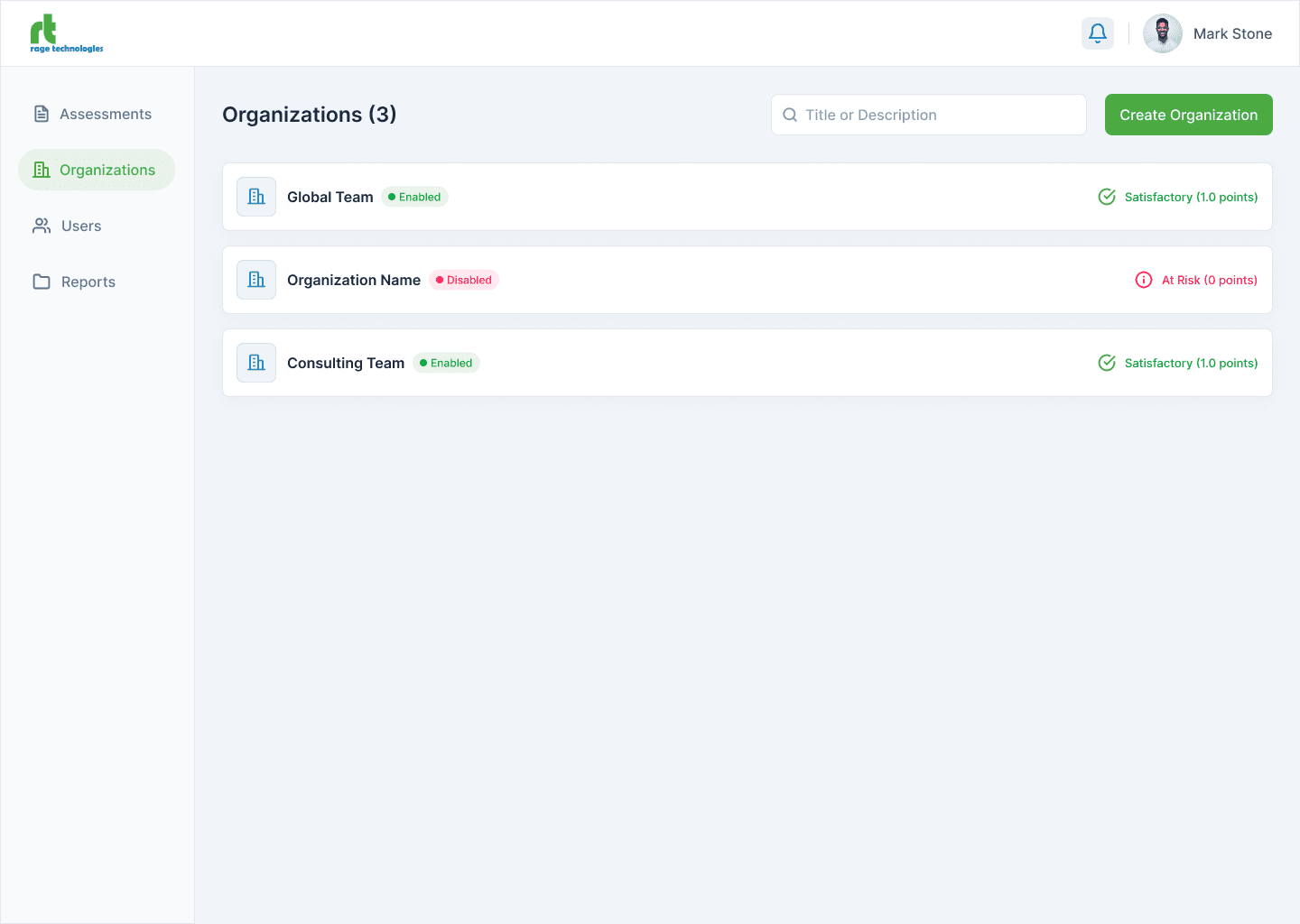
Priority Soft designed and built a standalone web platform for that job. Administrators can manage organizations, create assessment templates, assign them to the right users, review responses, compare results over time, and produce client-ready reports. Site users receive a much simpler experience for answering the questions assigned to them.
The product moved from wireframes through production setup and handoff. RageTech now operates software built around its service instead of fitting its process into a larger vendor's product.
Two experiences over one assessment model
The people completing an assessment may use the platform only a few times each year. They need a clear assignment, plain navigation, saved progress, and confidence that submission worked. RageTech administrators use the system far more deeply to manage templates, schedules, organizations, scoring, and reports.
The platform gives organization users their current and previous assignments, completion progress, and active category. Administrative navigation exposes the wider library and portfolio controls.
Both sides use the same assessment model. An assigned question retains its category, response type, and scoring behavior. The difference is in what each role can create, edit, review, or report.
This keeps occasional users away from internal complexity while giving the RageTech team the control required to deliver a consistent service across many sites.
Templates that can improve without rewriting history
Technology assessments evolve. Questions may be clarified, categories reorganized, or scoring adjusted as the service matures. A platform has to support those changes without silently altering the meaning of a report produced earlier.
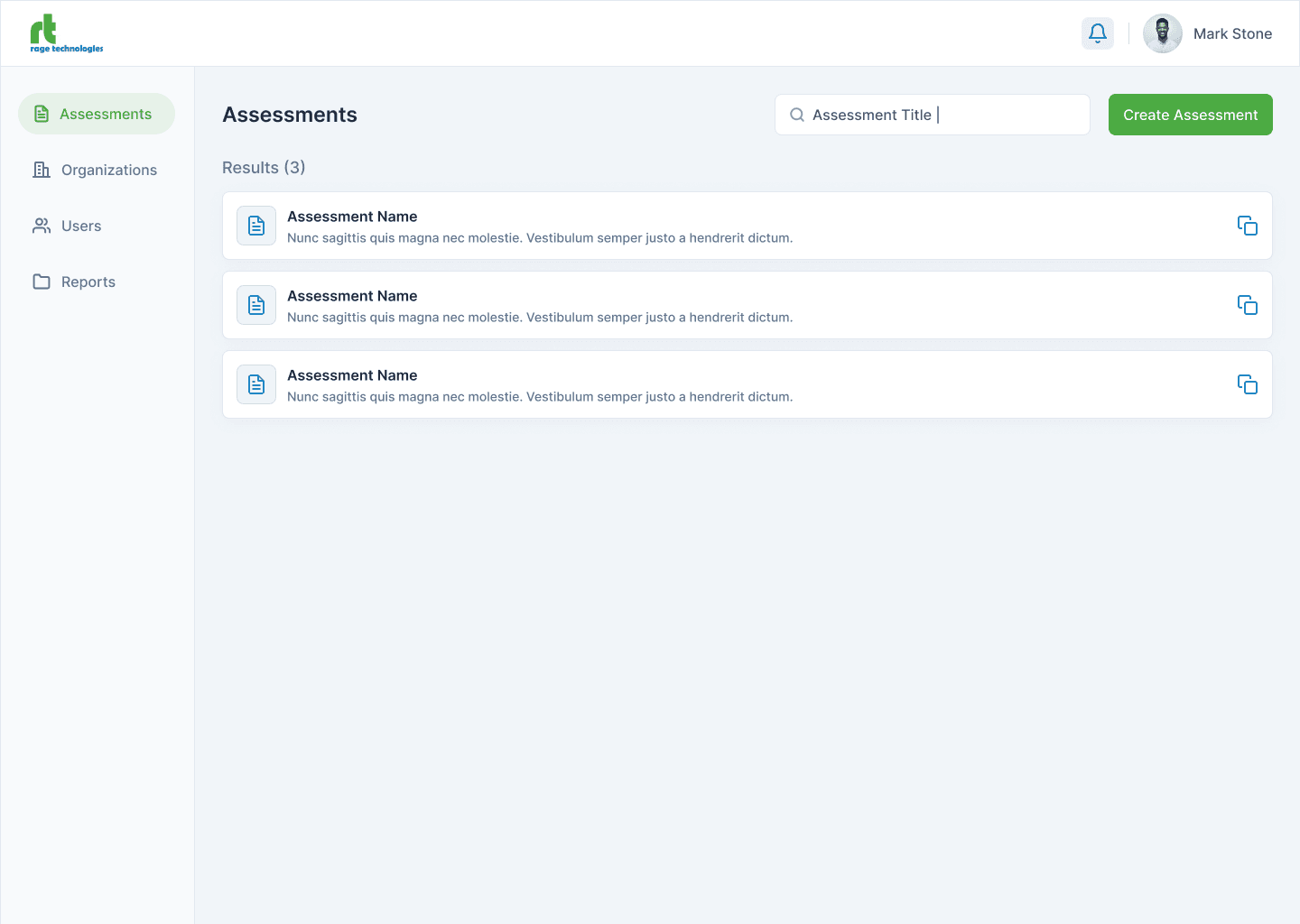
RageTech stores assessment templates separately from assignments and completed responses. Administrators can maintain a reusable library of categories and questions, then create an assignment from the appropriate template.
Each assignment preserves the assessment used for that period. Later template improvements can shape future work while prior submissions remain historically understandable.
The authoring experience supports different response types and scoring rules without requiring an engineer to add every question. Administrators can build structured assessments around text, choices, numeric responses, and supporting evidence while keeping the completion interface consistent.
Assignment that includes timing and recurrence
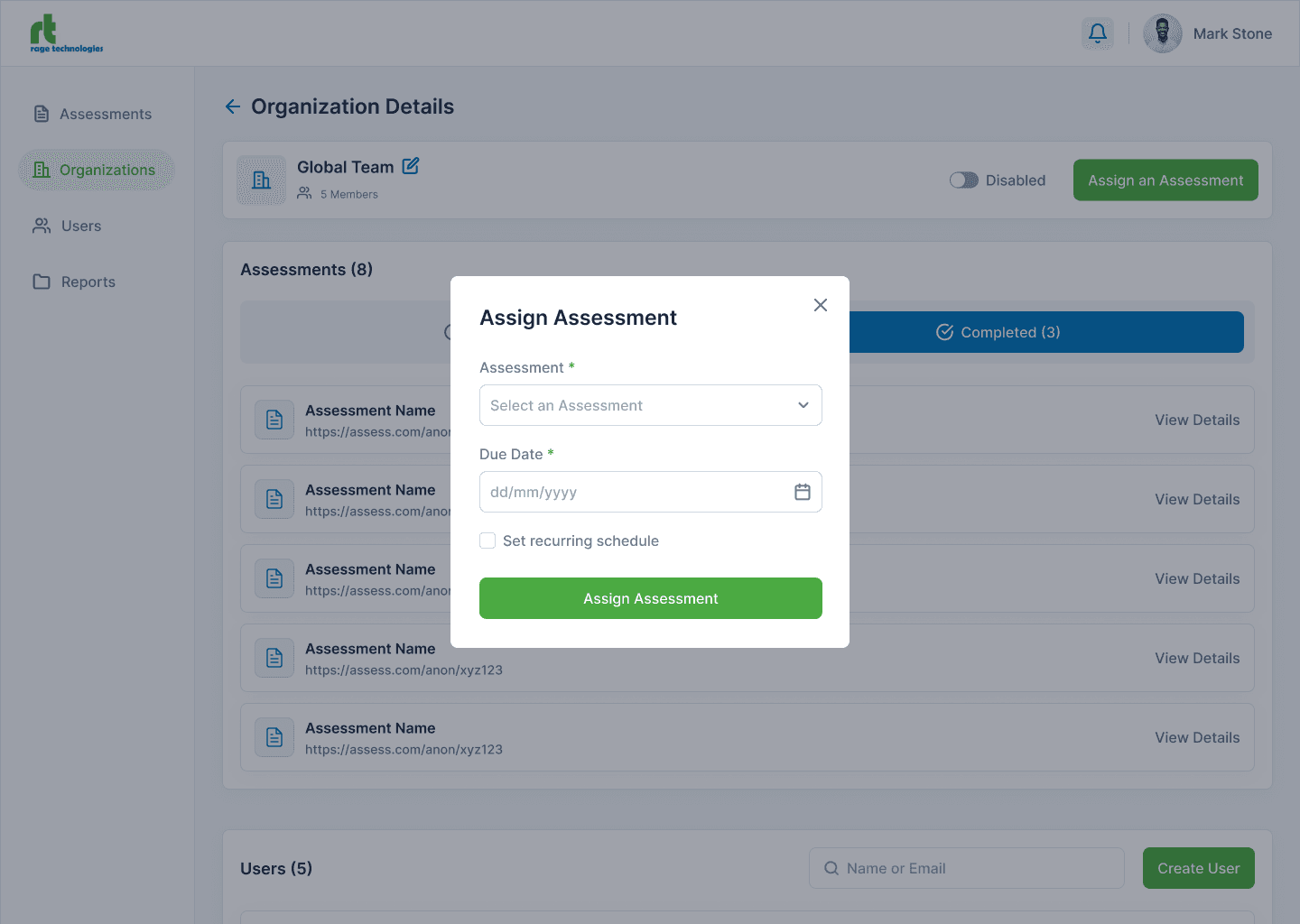
An assessment is not useful until the right organization and users know they are responsible for it. RageTech administrators can choose a template, assign it to an organization, set the relevant timing, and decide whether the work should recur.
Recurrence sits inside the assignment model. Scheduled processing creates the next assessment at the appropriate interval without asking staff to rebuild the same setup for every site.
The new assignment remains separate from the earlier response. That gives administrators a fresh reporting period while preserving a clear link for historical comparison.
Status shows the RageTech team what has not started, what is in progress, and what has been submitted. Users see their assigned work, not the company-wide schedule.
A completion flow designed for infrequent users
Most site participants will not learn a complex assessment tool. The interface has to explain itself each time they return.
RageTech groups questions into understandable categories and shows progress through the current assignment. Users can move through sections, provide the required response or evidence, and save a draft before the assessment is complete.
Partially completed sessions can resume without losing answers. Submission requires a final action and does not happen when a user leaves the page.
Validation appears near the relevant question. The product explains what remains incomplete without forcing the user to search the whole assessment. Once submitted, the state is clear to both the participant and the administrator reviewing it.
Scoring that remains tied to the response
RageTech calculates scores by category and across the full submission, showing which areas influenced the total.
Scoring rules stay attached to the assessment definition. Each response contributes according to its question logic, and category scores remain traceable to the submitted data.
The interface can show high-level results without publishing sensitive answers broadly. Authorized administrators can investigate the response detail when preparing findings, while organization access remains limited to the records assigned to that membership.
The public case study does not reveal actual questions, customer answers, or assessment findings. Those could expose weaknesses in a client's technology environment and belong inside the controlled platform.
Reports treated as a core deliverable
RageTech's service ends with findings that have to be communicated clearly. A spreadsheet export would move formatting and interpretation back onto the team each time.
The platform produces designed PDF reports from completed assessments. A full report can provide response and category detail. A summary gives decision makers a shorter view. Comparison reports show how an organization's position has changed between periods.
Server-side report templates use the same assessment and scoring as the screen. Generated PDFs preserve headings, page structure, and visual hierarchy instead of printing the browser interface.
Historical comparison gives repeat assessments a purpose. The client can see movement and recurring areas of concern without placing two unrelated documents side by side and reconstructing the differences manually.
Organizations, membership, and simple sign-in
RageTech works across several customer organizations, and assessment results must remain inside the correct boundary. Users belong to the organization they represent, while administrators can manage the wider portfolio.
Organization membership controls identity and data access. Users can retrieve permitted assignments but cannot change a URL or search term to reach another customer's assessment.
Google and Microsoft sign-in support familiar work identities. Secure email links provide an alternative for infrequent users who do not want another password. Invitations connect the chosen person to the correct organization before access begins.
Reducing sign-in friction was particularly important for a periodic workflow. The product keeps account entry simple without weakening the organization boundary behind it.
Administration without a separate back-office product
The RageTech team can manage users, organizations, templates, assignments, responses, and reports from one administrative experience. Search and status help staff find the part of the portfolio that needs attention.
Administration follows the assessment lifecycle. Creating an organization leads to inviting users and assigning work. A submitted assessment leads to results and reports. Recurrence creates the next period without losing its history.
Production migration and content checks were also treated as part of delivery. Templates, organizations, and users have to arrive in the live environment consistently for the application to be useful on its first day.
The handoff included the tools and operating structure required to continue that work. Priority Soft carried the platform beyond a design prototype and into a production-ready system.
A focused Next.js architecture
RageTech is built with Next.js, React, and TypeScript, with PostgreSQL holding organizations, membership, templates, assignments, responses, and report history. Better Auth supports federated and email-link sign-in.
Server-rendered report templates and Puppeteer create the full, summary, and comparison PDFs. Scheduled processing supports recurring assignments, while production monitoring provides visibility into errors after deployment.
The data model keeps template definitions, assignment snapshots, and responses distinct. This supports future authoring and historically stable reports.
The architecture stays close to the product's purpose. It does not reproduce an entire IT lifecycle suite. It provides the identity, assessment, scoring, recurrence, and reporting foundation RageTech needs to deliver its own service.
What Priority Soft brought to RageTech
We removed the unrelated scope of broad lifecycle software and focused the product on the assessment workflow.
We designed for occasional site users and expert administrators, preserved historical results when templates change, and included reporting in the service model. Identity and organization boundaries use the same model.
Our team then carried those decisions through design, development, production migration, and handoff. RageTech received an operating product, not a set of disconnected screens.
The outcome
RageTech gained a purpose-built assessment platform that runs from organization setup through assignment, completion, scoring, comparison, and client reporting. Users can complete periodic reviews with minimal training, while administrators retain control of templates and the wider portfolio.
Priority Soft replaced a mismatched software dependency with a product shaped around RageTech's own service. The platform preserves sensitive assessment detail, creates repeatable work across organizations, and turns submitted responses into reports the client can use.