Proving the boxing-pool experience before introducing real money
Boxing predictions become more interesting when friends compete across an entire fight card. Picking the winner is only one part of it. Fans may also predict how the fight ends and when, then compare their accuracy across a private group or a wider public pool.
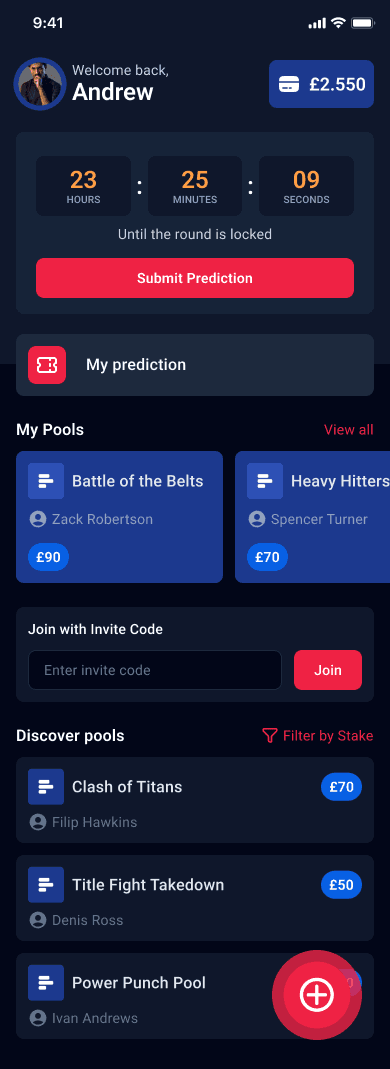
Round4Pound turns that behavior into a mobile product. Users can discover or create pools, join with an in-app point stake, complete predictions before the event locks, and see how official results affect the ranking afterward.
Priority Soft designed and launched the first production version with simulated points. Its balances and transaction records do not represent deposits or withdrawals. The client could test the prediction loop without releasing an unregulated money product.
Building the product around a boxing round
A boxing event contains several fights, and a prediction pool needs a stable way to group them. Round4Pound uses a round as the event boundary. Each round has its fight card, timing, prediction window, and result state.
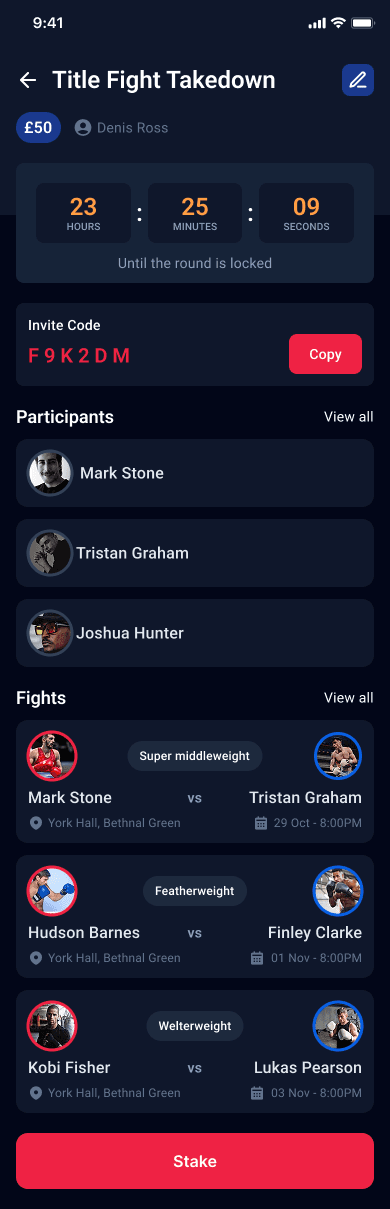
Users open the current round and can inspect each match before choosing a pool. Fight information remains consistent across the home feed, pool view, prediction form, and history.
The mobile app and backend use the same round model. Predictions attach to a known set of fights, the lock applies consistently, and administrators enter results once to score every relevant pool.
Completed rounds remain in history. Users can review their predictions, fight results, and final placement while the home screen stays focused on the next open card.
Public discovery and private competition
Round4Pound supports two social settings. Public pools give users a way to find broader competition. Private pools let a group of friends create its own table and share entry through an invite code.
The joining flow stays short. Users can browse public options, enter a private code, or create a pool and invite others. Pool detail explains the event, point stake, membership, and prediction state before they commit.
Private pools stay out of general discovery. An invite code controls access and saves the creator from managing memberships by hand.
Once joined, the member sees the same fight card and scoring rules as the rest of the pool. The social boundary changes, but the underlying prediction model remains consistent.
Predictions with enough depth for boxing fans
Choosing only the winner would make many entries identical. Round4Pound allows a member to predict the fighter, result method, and round range for each match.
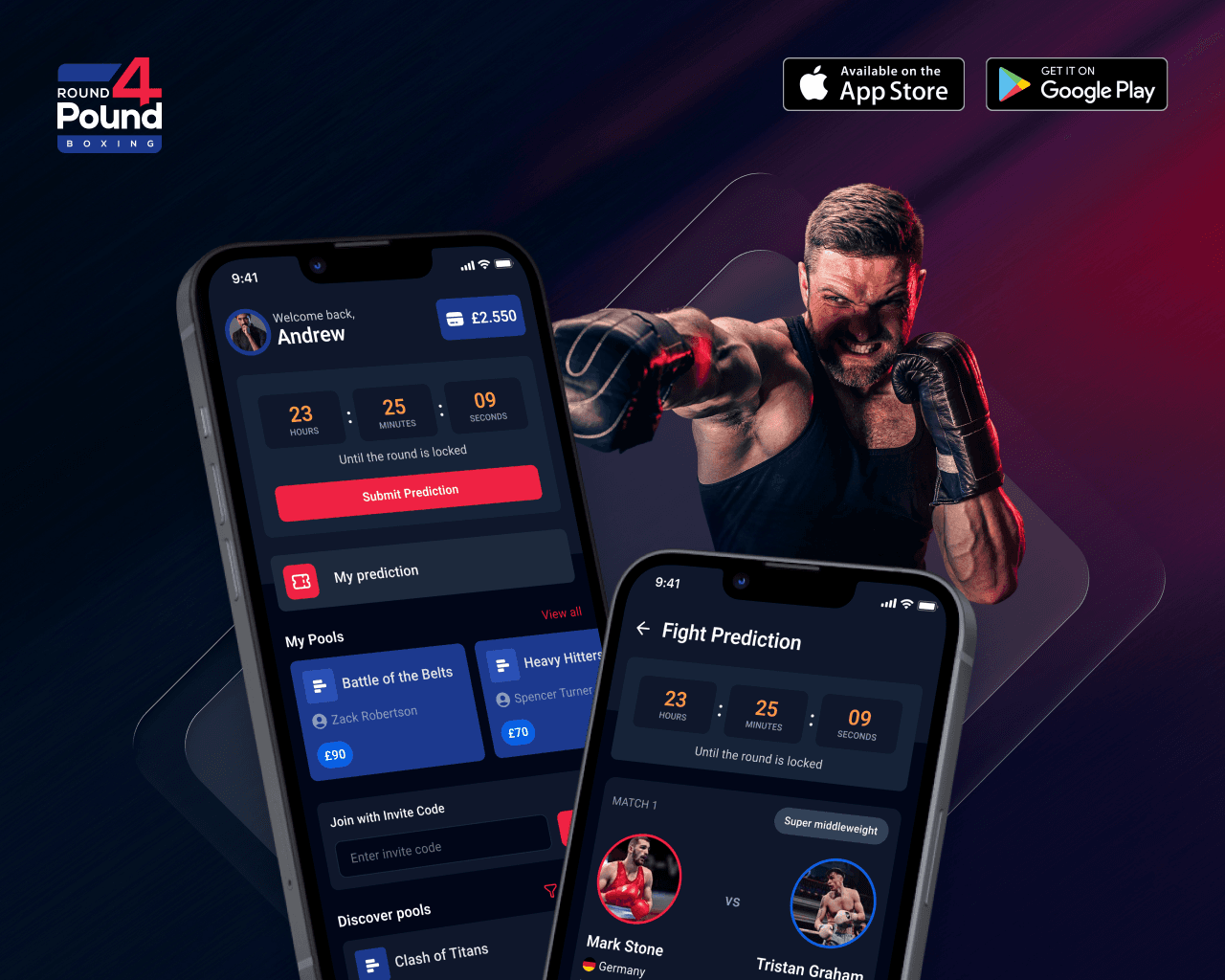
The mobile flow breaks those choices into clear controls and shows progress through the fight card. Users can save or update their selections while the round remains open, then review the complete entry before lock.
The interface distinguishes a partial card from a completed one. When members return, the app opens the unfinished fights and keeps their previous choices.
Each match and its choices have enough space on a phone. The screen includes the information needed for a prediction and leaves out unrelated fighter statistics.
A clear lock before the first bell
Fair scoring requires a point when entries stop changing. Round4Pound locks predictions at the configured event boundary and presents that state consistently across the pool and fight views.
The lock sits in the service layer, where an old screen or local device time cannot bypass it. The mobile interface explains when prediction is open and removes editing after the boundary passes.
Post-lock behavior received particular attention. Users can still view their selections and follow the event, but the stored entry remains stable for scoring.
The service records which predictions were active when the event began. Every member is scored against that same locked card.
Official results and transparent scoring
The platform needs one controlled source for fight outcomes. In the released product, authorized administrators record the official winner, method, and round after each fight.
The backend compares those results with every locked prediction and calculates the relevant score. Pool rankings then update from the same result set, while member history preserves the individual choices behind the total.
Application code calculates the scores after an administrator enters the official result. That one entry updates predictions, pool standings, balances, and notifications.
Corrections can be handled through the controlled administration path. Users see the updated product state without receiving access to the tools that establish the official result.
Simulated balances with a real ledger model
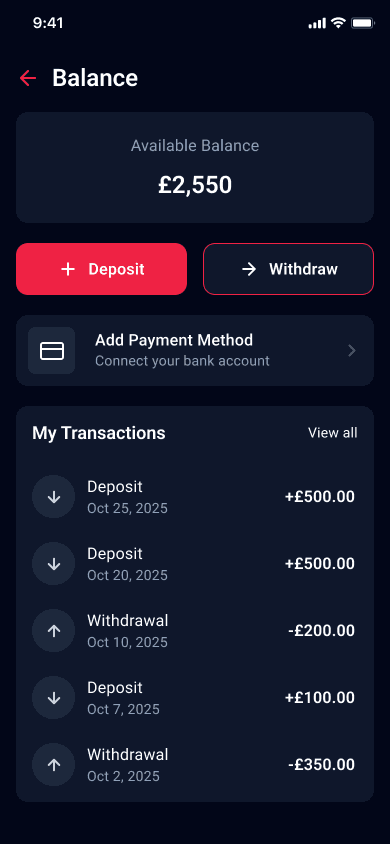
Round4Pound presents a balance, pool stakes, transaction history, and deposit or withdrawal concepts as part of its product design. In the launched free-play version, those values are simulated points. No real money moves through the application.
Each balance change becomes a transaction. Joining a pool, receiving a result, or qualifying for a refund creates a traceable history entry.
This approach made the free-play experience complete and understandable. Members can see why their point balance changed, and the platform can correct or refund a specific event without rewriting unrelated history.
The ledger gives future regulated work a clearer starting point. A real-money version would still require payment-provider approval, identity checks, licensing, age controls, and responsible-play operations. The launched product has none of those capabilities.
Handling small pools and refunds fairly
Prediction products also need rules for small pools and changed events. A private pool may have only one entrant, or an event may change before scoring.
Refunds are part of the ledger and pool workflow. If a pool lacks enough competition, the service returns the simulated stake and records the refund in the member's history.
The service handles these cases through defined rules and recorded adjustments. Members can see why their balances changed without contacting an administrator.
The released system can complete the free-play cycle when a pool stays small or an event changes.
Identity, notifications, and history
Round4Pound includes onboarding, account access, profiles, secure local session storage, and notification setup. Firebase supports identity and mobile messaging.
Notifications cover open prediction windows, approaching locks, and completed results. Deep links open the relevant round or pool.
History uses the same event and prediction records as scoring. Users can revisit earlier rounds and compare results with their choices.
Error monitoring gives the team visibility into production problems without asking users to describe technical failures. Sensitive profile data and private pool activity remain inside the authenticated product.
Administration that controls the competition
Authorized administrators manage the rounds, fight cards, timing, official outcomes, and scoring events that keep the product running. The work is separate from the member application but uses the same data foundation.
Administrative actions follow the competition lifecycle. A round is prepared, opened for predictions, locked, resolved with official results, and moved into history. Pool and transaction exceptions remain available in context.
Administrators have one controlled path for running the competition, while members never see those tools. The client can connect verified sports data later if needed.
Administrative controls and member records stay inside authorized product roles. The public product remains defined by the released free-play system and its clear boundary around regulated scope.
A mobile and service foundation for live events
Round4Pound uses Expo, React Native, and TypeScript for the iOS and Android application. Expo Router organizes onboarding, account, home, pools, prediction, balance, transaction, history, and profile screens.
A Django service layer with PostgreSQL manages users, rounds, fights, pools, memberships, predictions, results, and the simulated transaction ledger. Firebase provides identity and notifications, while managed storage supports media. Sentry and Crashlytics provide production error visibility.
Client state remains separate from server-backed event data. The app handles responsive selection, while the service remains authoritative for membership, lock time, scoring, and balance state.
That boundary matters in a prediction product. A device can display a choice, but it cannot decide that a late edit should count or that a balance changed without a ledger event.
What Priority Soft brought to Round4Pound
Priority Soft helped the client choose a responsible first product. The fun of pool creation, fight predictions, scoring, rankings, and social competition could be tested with points. Real-money operations would have introduced a completely different standard of licensing, identity, payments, and oversight.
We designed and built the full free-play loop. The service enforces prediction locks, scores official results, and records every balance change. Public and private pools use the same event model.
Round4Pound launched a complete points-based product with any future regulated work kept outside the release.
The outcome
Round4Pound launched as a production boxing-prediction app built around simulated points. Fans can create or join pools, complete a full fight-card prediction, follow results, review rankings, and understand every change to their in-app balance.
The client can test social boxing predictions without claiming support for gambling or real-money wagering. The app covers the full free-play experience and documents what a regulated version would require.