
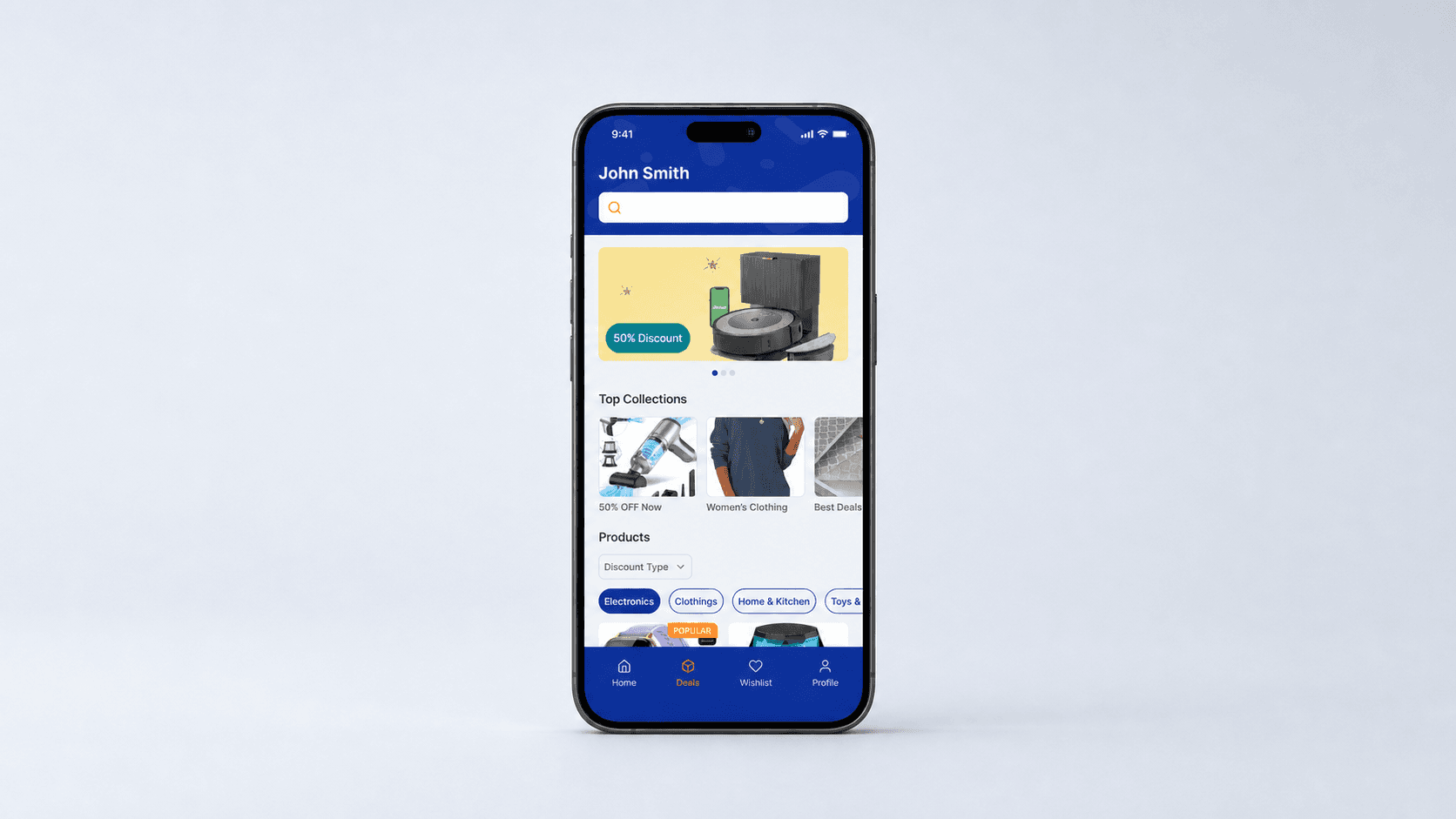
A shopping app for finding deals
Online marketplaces work well when a shopper knows what to search for. SMIT Deals caters to the person who wants to browse discounts or compare products without a specific search in mind.
SMIT Deals is a mobile discovery product for Amazon offers. It organizes products, coupon codes, and price drops into a curated feed for Hebrew- and English-speaking shoppers. Users can browse categories, save products, copy an available code, and continue to Amazon to complete the purchase.
Priority Soft helped reduce a broad social-commerce concept to a focused first product, then designed and built the mobile application and the data platform behind it. The work covered product strategy, right-to-left design, mobile interaction, offer ingestion, authentication, wishlists, notifications, analytics, and store-readiness.
Finding the sharpest version of the idea
The original concept included short-form shopping video and user-created content. It was ambitious, but it introduced a cold-start problem before the central reason to use the app had been proven. A content network needs creators to attract shoppers and shoppers to attract creators, along with moderation and media infrastructure from the beginning.
Priority Soft challenged that scope during discovery. The more useful first question was whether shoppers would open a dedicated application to find relevant, well-presented deals before going to Amazon.
The product pivoted to curated coupons and price drops. That decision removed video creation, creator tools, feeds, and moderation while retaining the core behavior: open the app with buying intent, discover an offer, and continue to the retailer.
That smaller scope gave the team time to improve discovery, categorization, localization, data freshness, and coupon use. The first release could focus on one business model.
A home screen made for browsing
SMIT Deals opens with products. Shoppers can start with a featured collection, a category, an editor's pick, or a current offer without typing a search.
Priority Soft designed compact product cards that balance image, title, current offer, brand cues, delivery information where available, and a direct wishlist action. Cards provide enough context to decide whether a product deserves attention without turning the feed into a spreadsheet.
Category navigation remains within thumb reach, and each section keeps its own filters. A shopper can explore electronics, move to another category, and return to the same view.
The feed rotates over time so popular items do not hold the first positions forever. Curated collections let the client decide which products deserve extra attention.
Product detail that explains the next step
A deal card earns the tap; the product screen has to justify leaving the app. SMIT Deals presents the available images, product information, offer type, current amount, rating context where supplied, and the action appropriate to that offer.
Coupon products require one set of actions, while direct price drops require another. A shopper copies a coupon code and applies it during checkout. A price drop may require only a visit to the retail listing. Priority Soft gave each offer type a call to action that explains the next step.
When a code is available, the app copies it to the device and provides visual confirmation before opening Amazon. Built-in help overlays show where the code can be entered on the retailer's checkout screens.
The handoff remains explicit. SMIT Deals helps users discover and prepare an offer; Amazon owns the product listing, account, checkout, fulfillment, and final eligibility of the discount.
Designing for Hebrew from the foundation
Hebrew support affects the whole interface. Direction, navigation, icon placement, mixed-language product names, amounts, truncation, and visual emphasis all need to work from right to left.
Priority Soft designed SMIT Deals as a bilingual product from the data model upward. Product names, descriptions, brands, categories, and supporting content can carry Hebrew and English versions. The service returns the language that the user selected, so the mobile interface never has to improvise a translation.
Layouts respond to direction as well as text length. Bottom navigation, search, filters, cards, detail views, authentication, profile, and instructional overlays maintain the expected reading order in each language.
Starting with both languages avoided a common problem: translated text inside spacing, controls, and hierarchy built for left-to-right reading.
A brand integrated into a working system
The visual identity uses deep blue, bright orange, warm off-white surfaces, and a contrasting action color for the retailer handoff. It feels energetic without looking like a crowded discount flyer.
Priority Soft translated external brand work into a complete interface system. We checked color values, typography, component states, spacing, and asset behavior before applying them across the Figma designs and mobile code.
Product imagery stays at the center. Navigation, chips, buttons, typography, and empty states carry the brand without competing with the catalogue.
The app uses a light presentation chosen for shopping clarity. Loading states, unavailable images, long titles, missing coupons, and mixed content received the same treatment as the polished marketing frames.
Sign-in without a password-heavy detour
The client wanted an account relationship from the start, but a long registration form would work against the quick browsing experience.
Priority Soft implemented social sign-in through the major identity providers supported on each platform. The app receives a verified identity and creates the product profile required for preferences, wishlist synchronization, and notifications.
The onboarding sequence introduces the value of the product, establishes language, and lets users select categories that interest them. It is short enough to finish without a tutorial layered over the working interface.
The app shares authentication state with the service and keeps provider secrets out of the mobile code. Users can sign out or delete an account through direct paths. SMIT Deals does not collect retail account passwords or payment details.
Wishlists that still work through ordinary disruption
Shoppers often want time before choosing a product. SMIT Deals lets them save an item from the feed or detail view and return to it through a dedicated wishlist.
The wishlist responds on the device as soon as the shopper taps the heart. If the network is unavailable, the app keeps the action and synchronizes it when the connection returns.
Local caching keeps loaded product content available through a weak connection. The app distinguishes that cached content from a new retailer handoff.
These native features mattered during mobile-store review. Saved state, offline behavior, device integration, and a designed shopping flow showed that SMIT Deals was a mobile product with more to offer than a list of web links.
A controlled pipeline for changing offer data
Deal applications depend on changing source material. Products appear and disappear, amounts change, coupons expire, and translations may arrive from a data partner in batches.
Priority Soft built an ingestion service that accepts structured bilingual product files. It validates each file and processes it in the background. Stable retailer references let repeated imports update known items without creating uncontrolled duplicates.
The service records each import as a batch. The public app reads from the active set, so a new delivery can replace stale catalogue data. The importer skips unchanged records and reports invalid rows without hiding the rest of the batch.
The client could manage product content in the first release without funding a large custom administration tool. This public case study omits the supplier, private feeds, field layouts, upload addresses, and access keys.
Search and filters that respect discovery
Shoppers with a product in mind can use search. Categories, subcategories, brands, collections, offer types, amounts, and sorting controls provide other ways to narrow the catalogue.
Priority Soft built the filter state so it belongs to the category being explored. Derived counts and results come from the same active product batch, reducing situations where a filter promises items that are no longer available.
The app opens full-screen controls when a set of options needs more room, then returns the shopper to the same feed position and state. Visible filter labels explain why the results changed.
The product can therefore support purposeful search and casual browsing without forcing either behavior into the other's interface.
Notifications and price interest without clutter
Users can follow products and supported offer changes. A notification opens the relevant item or collection.
Priority Soft gave Hebrew and English notifications their own channels. Device permission remains under the user's control. The app uses the same rules when a notification arrives in the foreground, in the background, or after a tap.
The device stores a small amount of price-interest state. When an eligible price changes, the service sends the alert. SMIT Deals can provide useful notifications without recording a private profile of each browsing action.
This public case study omits campaign performance, attribution identifiers, device records, and internal marketing settings.
Measuring the handoff without owning the purchase
SMIT Deals creates value when a shopper discovers an offer and visits the retailer. The app cannot see the final transaction, so its analytics cover onboarding, browsing, search, wishlists, coupon copies, and outbound product actions.
Priority Soft integrated mobile analytics and attribution so the client can see which acquisition sources and product experiences bring shoppers back. The team defines each event once and sends it through the appropriate analytics services, which keeps tracking consistent across screens.
Tracking follows each platform's consent rules. SMIT Deals has no access to Amazon checkout data and does not treat affiliate attribution as proof of a final purchase.
That boundary keeps the reporting honest. The team can improve SMIT Deals with behavior the app can observe. This case study does not expose private dashboards or invent commercial results.
Responding to mobile-store scrutiny
An early iOS review questioned whether the offer aggregator provided enough native value beyond external content. Priority Soft answered with evidence from the working application.
We documented offline product caching, synchronized wishlists, native authentication, push notifications, deep linking, haptic and clipboard interactions, platform privacy prompts, and device-aware performance. We also reviewed the copy and flow so the app's purpose was clear to reviewers.
The response described the outbound retail model as it worked. It explained what SMIT Deals does before the handoff and how the app behaves while the retailer is closed.
Apple and Google control store approval, so this case study makes no claim about current distribution. Priority Soft gave the client an evidence-based submission and prepared the product for the standards applied to aggregation apps.
One codebase for app, service, and shared rules
The mobile application uses React Native, Expo, and TypeScript for iOS and Android. Expo Router organizes onboarding, authentication, home, search, product, wishlist, and account screens. Zustand and React Query manage local interaction and service-backed data.
The service layer uses TypeScript, Express, and tRPC. PostgreSQL stores users, products, categories, collections, wishlists, and content records, with Drizzle providing typed access. Redis-backed background work handles catalogue imports without tying up the request that delivered a file.
The project is organized as a monorepo with shared schemas and validation between the service and application. Firebase supports identity, notifications, and product analytics. Mobile attribution, error tracking, translation management, and Expo build services support operation and release work.
Priority Soft keeps those technologies behind product boundaries. No private routes, record structures, environment addresses, application identifiers, analytics keys, or infrastructure secrets appear in this case study.
Priority Soft's role
Priority Soft questioned whether the original video marketplace could prove its value in a sensible first release. We helped the client focus the product on coupons and deals before starting implementation.
We designed the complete bilingual mobile experience, integrated an external brand into a consistent system, built a resilient product-data pipeline, and added the native behaviors required for a useful shopping app. We also navigated store feedback without promising outcomes controlled by Apple or Google.
The product stayed focused on what it could do well: help shoppers discover, understand, save, and use relevant offers before moving to the retailer.
The outcome
SMIT Deals became a substantial mobile product and service foundation for curated Amazon discovery in Hebrew and English. Users can browse categories and collections, search and filter products, save a wishlist, copy applicable coupons, receive supported alerts, and continue to the retailer with a clear understanding of the offer.
The client gained a repeatable way to ingest changing bilingual catalogue data and present it through a branded native experience. Priority Soft delivered the strategy, product design, application, backend services, integrations, and store-readiness work needed to reach that point.
The case study shows the value of the product without publishing the client's costs, private growth plans, supplier arrangements, commercial data, personal information, or sensitive technical details.