A trusted place for advice mothers already share
Mothers recommend products, routines, and local resources to one another each day. The context makes the advice useful, yet it often gets lost across private messages, group chats, and bookmarks.
The Mother Network puts those activities in one product. Members can find communities, ask questions, publish posts or polls, and review products. They can also build recommendation lists, save items, follow people they trust, and continue a conversation in private.
Priority Soft helped shape the idea in the first product workshops. We built the mobile and backend systems, live communication, search, and public web experience. Community conversations remain tied to the people who contributed them as they feed product discovery.
Starting with community, not a catalogue
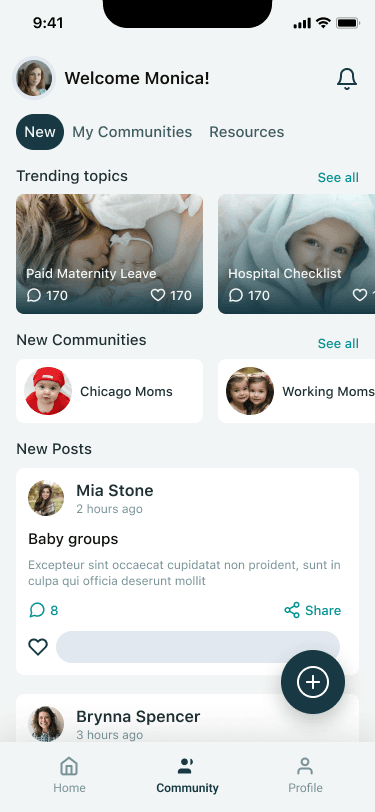
The first concept centered on a local network for mothers. Discovery showed that location was one of several useful connections. Members may also relate through a child's age, a shared experience, or the stage of motherhood they are in.
The community model supports different reasons for gathering. Members can discover a group, understand its purpose, request or receive access where needed, and follow relevant conversations.
Communities retain their own identity and membership boundary while participating in the larger network. Roles give leaders and moderators the controls required to guide a group without granting them platform-wide access.
This model supports communities beyond one place. Advice remains connected to its group and author, so members can see where it came from.
Onboarding that builds relevance with restraint
A new member should see useful material after a short setup. An exhaustive personal profile would delay that first experience.
The Mother Network introduces the platform, establishes account access, and collects the preferences needed to suggest communities and topics. Members can expand or revise their profile as they use the product.
Onboarding answers shape the first feed and community recommendations. Members control optional family and life-stage information from their accounts.
Members can sign in with email or the major mobile identity providers. The flow asks them to make notification and privacy choices.
Publishing that fits the question
A member may want an open discussion, a poll, a product recommendation, or a reply inside an existing topic. Each contribution needs a format that suits its purpose.
Publishing supports several intents. Posts carry conversation and media, polls compare responses, comments keep follow-up attached to the original subject, and topics and tags return useful material to discovery.
The composer changes with the selected contribution so members see the fields and guidance relevant to what they are making. Draft state and validation reduce the chance of losing work or publishing an incomplete entry.
Likes, comments, follows, and sharing help a strong contribution move beyond its first audience. The source remains visible, preserving the person and community behind the advice.
Turning product mentions into durable recommendations
Members often discuss a product before anyone adds it to a formal list. Plain-text mentions lead to duplicate descriptions and make reviews hard to compare.
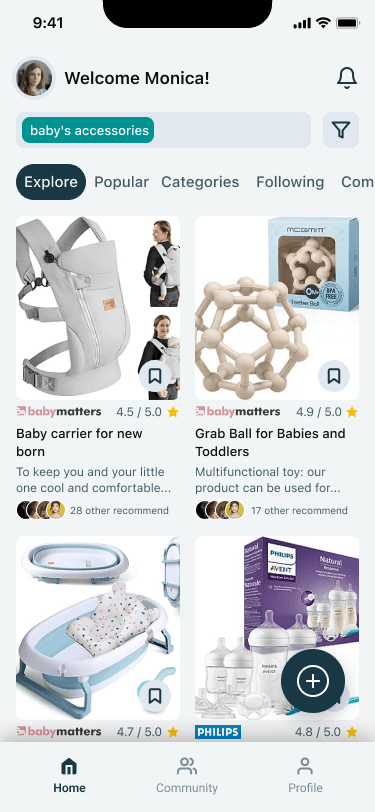
The Mother Network connects community conversation with structured product records. Brands, categories, product details, reviews, saved items, and member recommendations provide a stable layer beneath the social content.
Product links remain secondary to the conversation. A member writes the post and attaches a relevant product when needed. Readers can open the product, see other recommendations, save it, or add it to a list.
This structure makes advice reusable. A product discovered in one community can later appear in search, a profile, a themed list, or a related recommendation without copying the original conversation into several disconnected records.
Lists that preserve practical knowledge
A recommendation is often more useful as part of a set: travel essentials, feeding products, books for a particular age, or items that helped with a specific routine.
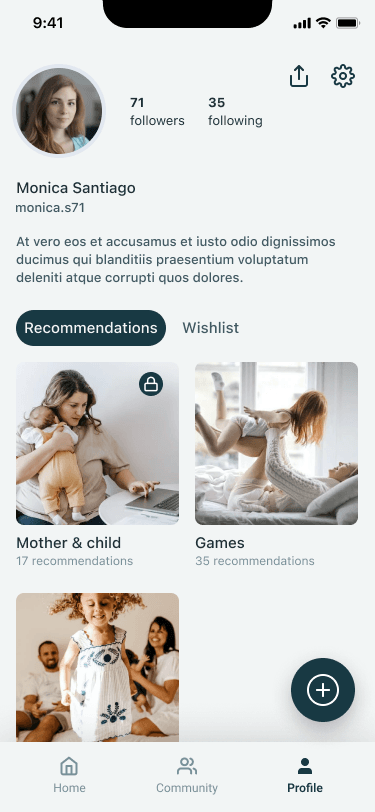
Members can create lists, organize products, add context, and choose who can see them. A private wishlist offers a faster way to remember individual items.
Lists use the same product and profile model as the rest of the platform. Product changes do not create unrelated copies inside every list, and the author remains visible on shared public collections.
Selected lists can also appear on the public web layer, giving useful editorial content a life outside the signed-in feed. Private lists and saved items remain behind the member's account permissions.
Profiles that make trust understandable
Advice is easier to assess when readers know who provided it and how that person participates in the network. The Mother Network uses profiles to connect contributions without exposing every part of a member's activity.
A profile can bring together the member's public introduction, communities, posts, lists, product reviews, recommendations, and following relationships according to the selected visibility settings.
One member identity spans every content type. A person does not become one author in the community area and another in product reviews. Readers can recognize their contributions and choose to follow them.
Public profiles show selected information. Sharing one list or post does not expose private community activity, family context, messages, or account data.
A feed that reflects chosen relationships
An endless generic feed would weaken the reason The Mother Network exists. Members need a useful blend of community activity, people they follow, selected topics, and recommendations that match their interests.
Feed and discovery signals come from membership, follows, tags, categories, saved activity, and current content.
The platform labels editorial selections and personal recommendations as different sources. Members can search or open a community when they want to choose the context themselves.
Recommendation support can use similarity and language-based techniques behind the scenes, but the experience remains grounded in recognizable people, groups, and topics. The public story does not expose ranking formulas or private behavioral records.
Search across people, communities, and things
The same phrase may refer to a community, a product, a post, a list, or a local resource. Search has to help members move across these different content types without mixing them into an indecipherable result set.
The Mother Network indexes content intended for discovery and groups results by type. Filters and tags narrow the response. Profile and community labels show the source of each item.
The search index remains separate from primary records. The platform controls permissions and content state, while the search service handles retrieval. Private database records never enter public search.
When content changes or is removed, background work keeps the index aligned. Search is therefore an access path into the product, not a parallel copy that ignores privacy and moderation decisions.
Private conversations connected to public context
Some advice starts in a community and becomes personal. Direct conversations let members continue in private within The Mother Network.
Real-time chat uses authenticated relationships. New messages appear without refreshing the application, conversation history remains available, and notifications open the correct thread.
Messages are kept separate from public profiles, community search, and indexable web content. The product can recognize that a conversation exists without treating its contents as recommendation data.
Blocking, reporting, and moderation boundaries are part of making social interaction usable. They give members a route to protect themselves while keeping platform administration distinct from ordinary community leadership.
Local resources, perks, and useful next steps
Community advice often points beyond a product. A member may need a local service, a family-friendly place, an event, or a network benefit.
The Mother Network includes structured areas for local resources and perks. These items can be categorized, searched, saved, and related to the appropriate community or location without becoming ordinary posts that disappear down the feed.
Resources connect to the existing discovery and profile systems. Members can find one through search, share it from a conversation, or follow its public external link.
Private commercial arrangements and individual use records remain outside the public case study. The product experience is about helping a member understand what is available and why it may be relevant.
A public web layer that supports sharing
Mobile applications are strong for repeat use, notifications, and community participation, but useful public content should also be shareable with someone who has not installed the app.
A companion React web application presents selected profiles, posts, lists, and perks. These pages open in an ordinary browser and give search engines a controlled view of approved public content.
Deep links connect the web and mobile app. An installed app opens the matching screen. Other visitors can read the public content in a browser and decide whether to continue.
The web layer does not mirror the private application wholesale. Community membership, messages, personal saves, and protected account information remain outside the public site.
Notifications that return to the right context
Social products can overwhelm members if every like or update becomes an interruption. The Mother Network groups notification behavior around actions that have a clear relationship to the user.
Members can receive updates for relevant community activity, replies, follows, invitations, direct messages, and selected product or list events. Each notification carries enough context to open the correct screen.
Mobile push connects to an in-app notification history. A dismissed device banner does not erase the update, and read state stays synchronized with the account.
Preferences give members control over supported categories of communication. Device tokens, delivery records, and individual engagement data stay within the platform's protected operation.
Privacy and account control in a personal community
The platform can hold profile information, family context, community activity, messages, and recommendations. Privacy rules apply inside the working product as well as in its policies.
The platform includes authentication, membership checks, content visibility, profile controls, blocking, reporting, and account-data workflows. Reads and writes are authorized according to the member and the content boundary involved.
Public pages expose material approved for public discovery. Search cannot reveal a private group, and a public profile cannot reveal direct messages or private lists. Members have defined paths for account deletion and data requests.
This case study omits member identities, family information, private posts, messages, engagement records, and internal moderation cases.
A platform across mobile, web, and real-time services
The mobile application uses Flutter and Dart with feature-specific state management and declarative navigation. It covers onboarding, home, search, communities, publishing, products, reviews, lists, profiles, messages, notifications, perks, resources, and settings on iOS and Android.
The service layer uses Django, Django REST Framework, and PostgreSQL. Domain modules separate users, profiles, communities, products, posts, lists, chat, notifications, perks, and resources. Redis and background workers handle jobs that should not delay a member's request.
Real-time messaging uses WebSockets. Meilisearch supports discovery, and private object storage handles member media. Firebase services support mobile messaging and selected hosting needs, while SendGrid manages transactional email and Sentry provides production error visibility.
The companion web application uses React and Vite. Priority Soft connected all three surfaces through consistent identity, content rules, and deep links without publishing routes, schemas, storage addresses, or provider secrets.
Priority Soft's role
Communities provide context, profiles identify the people behind the advice, and structured products and lists preserve recommendations for search and public pages.
We worked across strategy, UX, mobile engineering, backend services, live messaging, search, and web delivery. After launch, we continued to improve discovery and content quality based on how members used the product.
The team protected the distinction between public contribution and private membership throughout. That judgment matters in a network built around personal experience.
The outcome
The Mother Network developed from a local-community concept into a launched social and recommendation platform. Members can find relevant groups, contribute in several formats, follow trusted voices, review and save products, build lists, exchange private messages, and discover local resources or perks.
Selected content can reach people through the web and return them to the matching place in the mobile application. The shared platform keeps identity, products, communities, search, and notifications connected behind that experience.
Priority Soft delivered the product strategy and engineering foundation for that breadth. Private communities, family details, messages, commercial arrangements, ranking behavior, and internal operations remain outside the public product.