Turning employer files into reviewable ACA reporting
Affordable Care Act information reporting begins with data collected for other purposes. Employer details may live in one source, payroll in another, and health-coverage information in a third. Headings differ, employees appear more than once, and a small inconsistency can affect several months of a form.
Thousand Squared gives employers and service teams a controlled route through that work. Users create a reporting business, upload source files, approve how columns should be interpreted, reconcile employee records, review diagnostics, inspect calculated forms, and generate the required output.
Priority Soft designed and built the production platform, parsing pipeline, compliance calculation library, document workers, and release infrastructure. AI helps interpret unpredictable source files. Deterministic rules handle filing decisions that teams need to repeat and explain.
A reporting problem hidden inside ordinary spreadsheets
Two employers can provide the same information under different headings. One file may contain a full name, while another separates it. Coverage may appear as dates, month flags, or internal labels. Payroll exports can repeat an employee across periods.
The platform must identify each column, transform the row into a canonical record, and show the user how it interpreted the source.
Priority Soft organized imports by source purpose. The platform handles demographic, payroll, and coverage files on their own terms, then reconciles them within the same reporting business and period.
The original upload remains an input artifact. Mapping and validation must finish before its values enter the reporting record.
Learning from an AI-heavy proof of concept
The first proof of concept asked a language model to read unfamiliar source files and produce normalized employee data. It recognized many variations and helped the team understand the problem.
Large and inconsistent files exposed the weakness of using the model for the entire pipeline. Results took longer, cost varied with file size, and the same source could not be guaranteed to produce an identical structured result every time.
Priority Soft did not force that prototype into production. We separated the useful part from the risky part. Model assistance became a way to classify a file and suggest what unfamiliar columns may represent. Ordinary spreadsheet and CSV processors handle row extraction. Versioned code performs normalization, validation, reconciliation, and ACA calculations.
That boundary made the platform more flexible at the point of entry without placing tax-form decisions inside an opaque model response.
Mapping approval before data becomes authoritative
An inferred column mapping can be helpful and still be wrong. A field called status, for example, may refer to employment, enrollment, or an internal workflow.
Thousand Squared presents proposed mappings for review before committing imported rows to the reporting workspace. The user can see the source heading, the canonical field it is expected to populate, and examples needed to judge the suggestion.
Priority Soft made mapping approval a required checkpoint. The approved mapping instructs the deterministic importer and becomes part of the source record.
If a diagnostic appears later, the service team can examine the approved mapping and trace how the value entered the platform. They do not have to guess what a model inferred in an unseen call.
Reconciling one employee across several sources
The same person may appear in demographic, payroll, and coverage files with small differences. Names can change format, rows can repeat by pay period, and one source may contain information another lacks.
Priority Soft built canonical employee reconciliation behind the import process. The platform applies identity and merge rules, preserves source relationships, and flags uncertain matches for review.
When two files conflict or a required identifier is missing, the platform creates an employee diagnostic. An authorized user can inspect the source context and correct the reporting record.
This avoids two dangerous outcomes: treating one person as several employees or combining distinct people into one record without review.
Diagnostics before form generation
Employee-level diagnostics let users correct reporting problems before a failed export at the end.
Thousand Squared runs validation after import and throughout the reporting workflow. Diagnostics identify missing values, inconsistent dates, unresolved source conflicts, and combinations that may prevent a sound code decision or valid output.
Priority Soft designed diagnostics as actionable records. Each item has a state, points to the affected employee or business context, and can guide the user to the area that needs attention.
Resolution does not erase the history. A corrected value, accepted exception, or controlled override remains distinguishable from the original imported material. The platform can therefore show both the current reporting answer and the work that led to it.
Monthly code decisions reviewers can trace
Forms 1094-C and 1095-C require reporting logic that operates across months and depends on employment, offer, coverage, and other applicable facts. A single annual label cannot represent every situation.
Priority Soft isolated calculation rules in a TypeScript library. The library validates structured inputs and evaluates the conditions for each month, producing form values and diagnostics.
The library records why it selected a code or found the available information insufficient. Tests cover employment changes, leave, continuation coverage, and reimbursement arrangements as explicit scenarios outside the interface code.
This public case study does not reproduce the client's rule implementation. It explains the design principle: filing values come from versioned, testable logic with traceable output, not generated prose.
Review and controlled overrides
A calculation engine cannot infer facts missing from the source. Service teams need a controlled way to correct the reporting record while preserving the imported file.
Thousand Squared brings source data, diagnostics, calculated values, and generated output into its employee and form review screens. Authorized users can apply supported corrections or overrides and record the reason.
Priority Soft stores overrides apart from calculated values. The interface shows who changed a result, the reason, and the value the engine produced.
This history supports review and prevents a later calculation update from overwriting an approved reporting judgment.
Forms people can inspect before filing
A calculation result becomes more trustworthy when users can see it in the same structure they expect to deliver. Thousand Squared creates employee-level 1095-C material and the related 1094-C transmittal data from the reviewed reporting workspace.
Priority Soft built form views for individual review and worker-based generation for larger document sets. PDF output gives service teams and employers a human-readable artifact that can be checked, distributed through the appropriate process, or retained according to policy.
Generation jobs remain tied to the source business, reporting period, and version of the reviewed data. If a correction changes the form, the new artifact can be distinguished from the earlier one.
Sensitive employee documents are not placed at public addresses. Access follows the organization and user permissions applied throughout the platform.
XML prepared for the IRS AIR process
The IRS uses the Affordable Care Act Information Returns system for electronic submission of Forms 1094-C and 1095-C. That process has published schemas, business rules, acknowledgement files, and separate access and testing requirements for filers and software providers.
Thousand Squared generates the XML artifacts required for the supported filing package and diagnoses rejected or incomplete output within the platform's generation workflow.
Priority Soft kept XML creation outside the browser and based it on the same reviewed records used for form display and PDFs. The worker can validate structure, package the output, and preserve generation status without blocking an interactive page.
The production launch does not by itself establish an IRS Transmitter Control Code, AATS completion, acceptance of a specific submission, or authorization to file for any employer. Those are separate external statuses, so this case study does not describe Thousand Squared as IRS-certified.
Long-running work that does not freeze the product
Large imports, reconciliation, calculations, and document generation can take longer than an ordinary web request. Asking the user to keep one page open would make the process fragile.
Priority Soft moved those operations into background workers coordinated through queues. The application creates a job, the appropriate worker processes it, and progress events return to the browser as the job advances.
Users can leave the page and return to the reporting workspace. The persisted job state shows whether work is waiting, active, complete, or requires attention. A failed task can preserve a useful diagnostic without pretending that no attempt occurred.
This structure also separates resource-heavy parsing and document work from the interactive application. The platform remains responsive while the service processes larger files or batches of forms.
Multiple businesses and reporting periods kept distinct
Service teams may prepare reporting for several employers, and an employer may manage subsidiaries or related reporting entities. The platform needs to prevent records from leaking across those boundaries.
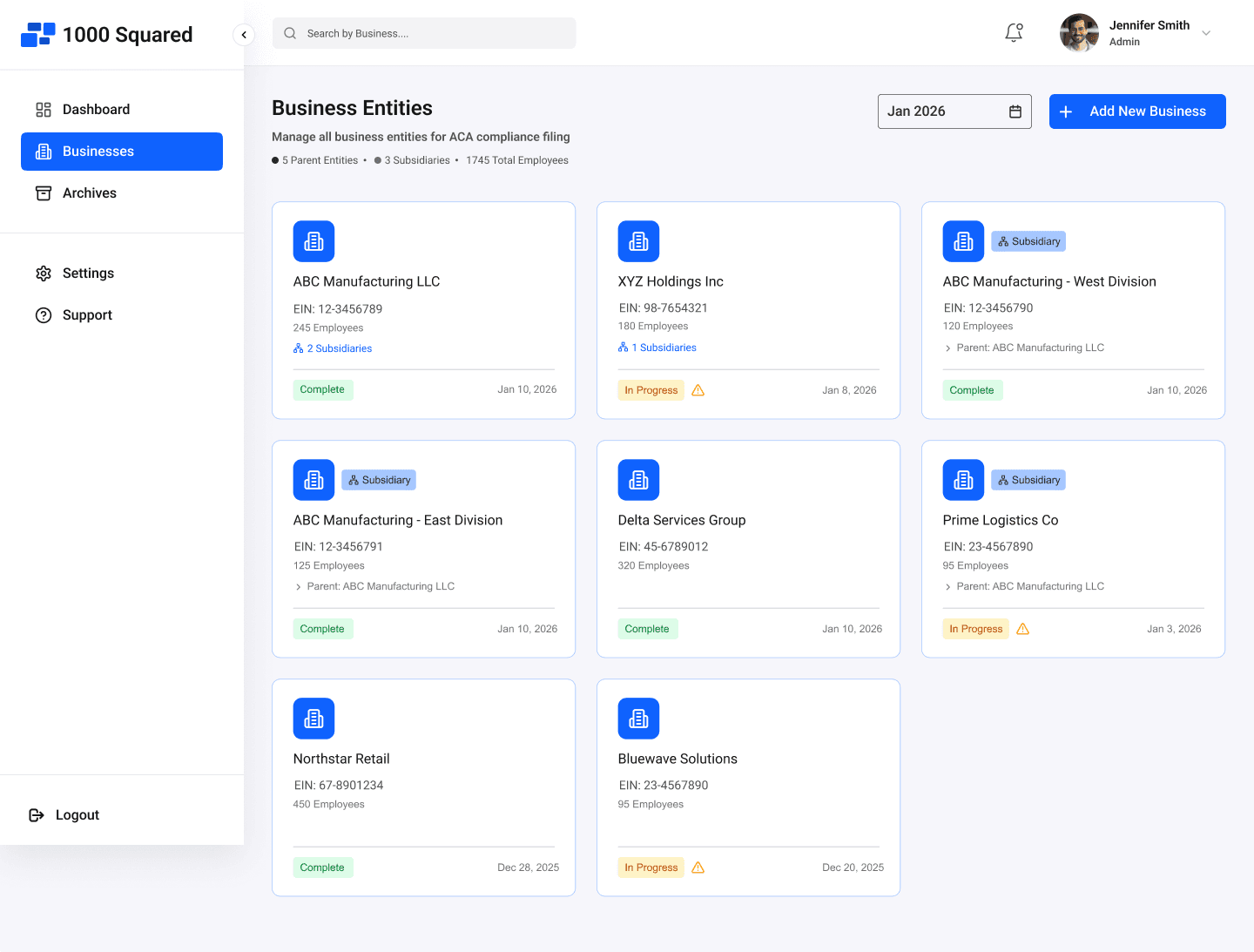
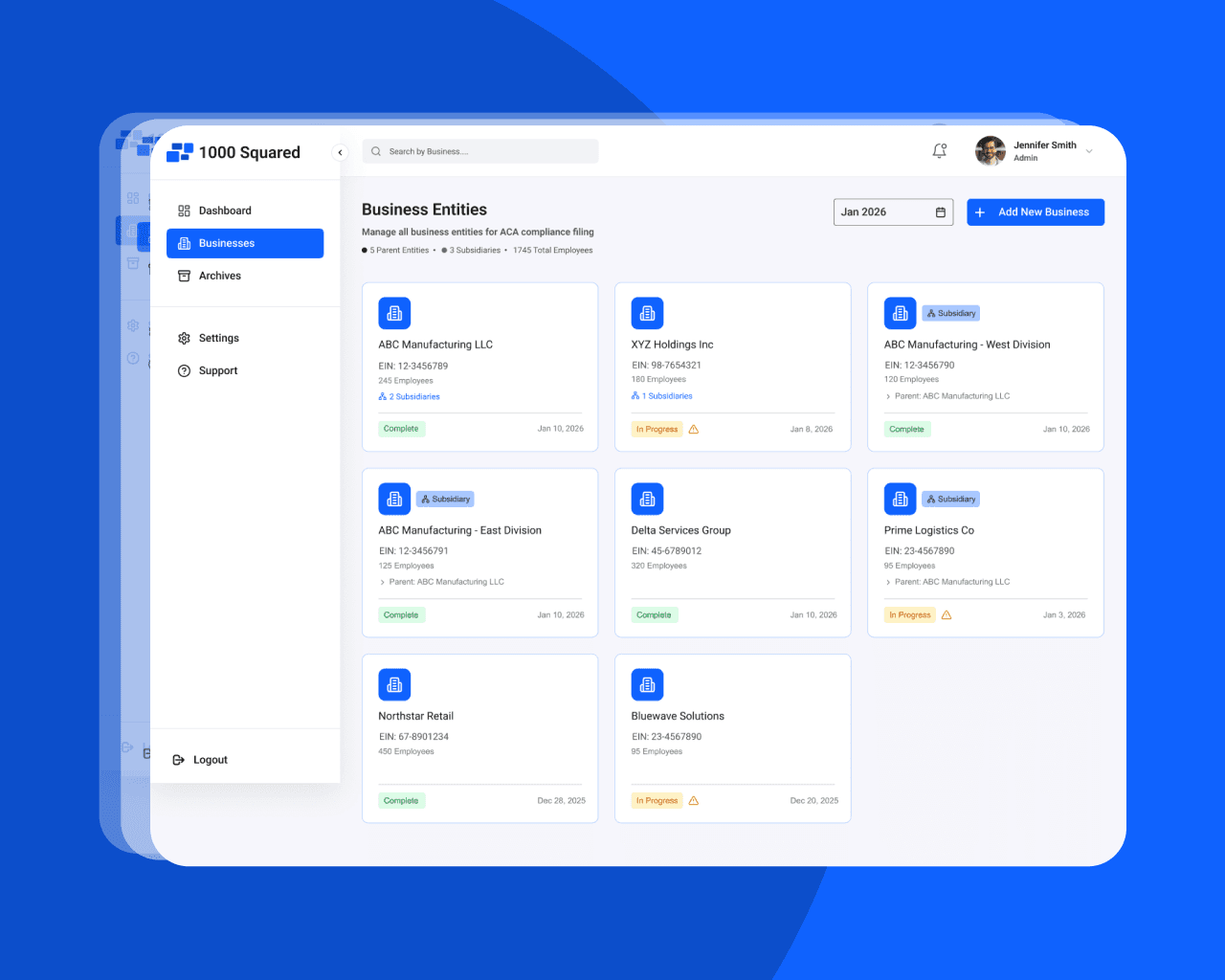
Thousand Squared organizes work by reporting business and year. Imports, employees, diagnostics, calculations, jobs, and artifacts inherit that context. Users navigate into the appropriate workspace before uploading or reviewing information.
Priority Soft made business selection part of the access model. The service uses the same organization and reporting-period relationships shown in the interface.
This case study does not include actual employer names, employee counts, tax identifiers, filing volumes, or organizational relationships. The accompanying product screen uses demonstration data.
Security for payroll, coverage, and tax data
The platform handles sensitive employee identity, employment, payroll, health-coverage, and tax-reporting information. Priority Soft separated uploaded files, processing jobs, canonical records, diagnostics, and generated artifacts so access can be controlled at each stage.
Private object storage holds source and generated files. The app authorizes each retrieval and keeps storage locations hidden. Secrets and provider access stay in managed deployment settings outside the browser and repository.
Logs identify failed work without copying raw employee records into broad-access diagnostics. Production and non-production environments remain separate.
No client file, employee identity, Social Security number, coverage record, payroll value, IRS identifier, or internal rejection detail is included in this public case study.
Separate tests for rules and workflows
Compliance software needs calculation and workflow tests. Defined scenarios check the rule library, while application tests verify that data reaches the correct business, period, employee, and artifact.
Priority Soft built automated tests around the ACA rules using structured inputs and expected decisions. Schema validation rejects malformed calculation requests before they can produce plausible-looking form values.
The platform and worker services add their own checks for imports, mappings, permissions, jobs, and generation. Staged environments provide a controlled route for migration and release work before production deployment.
Continued test coverage matters because reporting rules and annual specifications change. A versioned engine and reproducible scenario suite give the team a way to introduce an update without guessing which earlier cases may be affected.
A platform assembled from clear responsibilities
The web application uses Next.js, React, and TypeScript. PostgreSQL stores business, reporting, employee, diagnostic, and generation records. Typed data layers keep the main platform and calculation services explicit about the records they read and write.
Redis-backed queues coordinate parsing and document jobs. Private object storage holds source files and generated artifacts. Server-sent events return job progress to the browser without exposing worker internals.
The AI-assisted schema step is constrained to understanding unfamiliar file shape and proposing mappings. Deterministic processors extract rows, reconcile identities, validate records, calculate ACA codes, and create forms, PDFs, and XML.
Priority Soft joined these parts in a shared workspace while preserving service boundaries. The case study stays at that architectural level and omits routes, schemas, storage addresses, access secrets, deployment details, and private filing configuration.
Priority Soft's role
Priority Soft treated the engagement as a compliance product. We limited AI to the parts where it improved source-file interpretation.
We proved where model assistance helped, measured where it became slow or inconsistent, and redesigned the pipeline around reviewable mappings and deterministic processing. We created the canonical data workflow, diagnostics, versioned calculation library, controlled overrides, asynchronous generation, and production release foundation.
We also maintained an honest boundary around external authority. The platform can prepare forms and electronic-filing artifacts, but software release alone does not confer IRS access, testing status, or acceptance for a particular filer.
The outcome
Thousand Squared launched as a production ACA reporting platform that turns varied employer files into a review workspace. Users can approve mappings, reconcile employees, resolve diagnostics, inspect month-by-month form decisions, generate 1095-C and 1094-C material, create PDFs, and prepare XML for the AIR process.
Model assistance handles variation at import. Versioned rules make compliance decisions repeatable. Service teams can review a checkpoint at each major stage.
Priority Soft delivered that system without making the public story dependent on client data, private filing results, or certification claims the available evidence does not establish. Thousand Squared is software for preparing and reviewing reporting work; users remain responsible for applying current requirements and obtaining appropriate tax or legal advice.