
Helping a reading app get out of the child's way
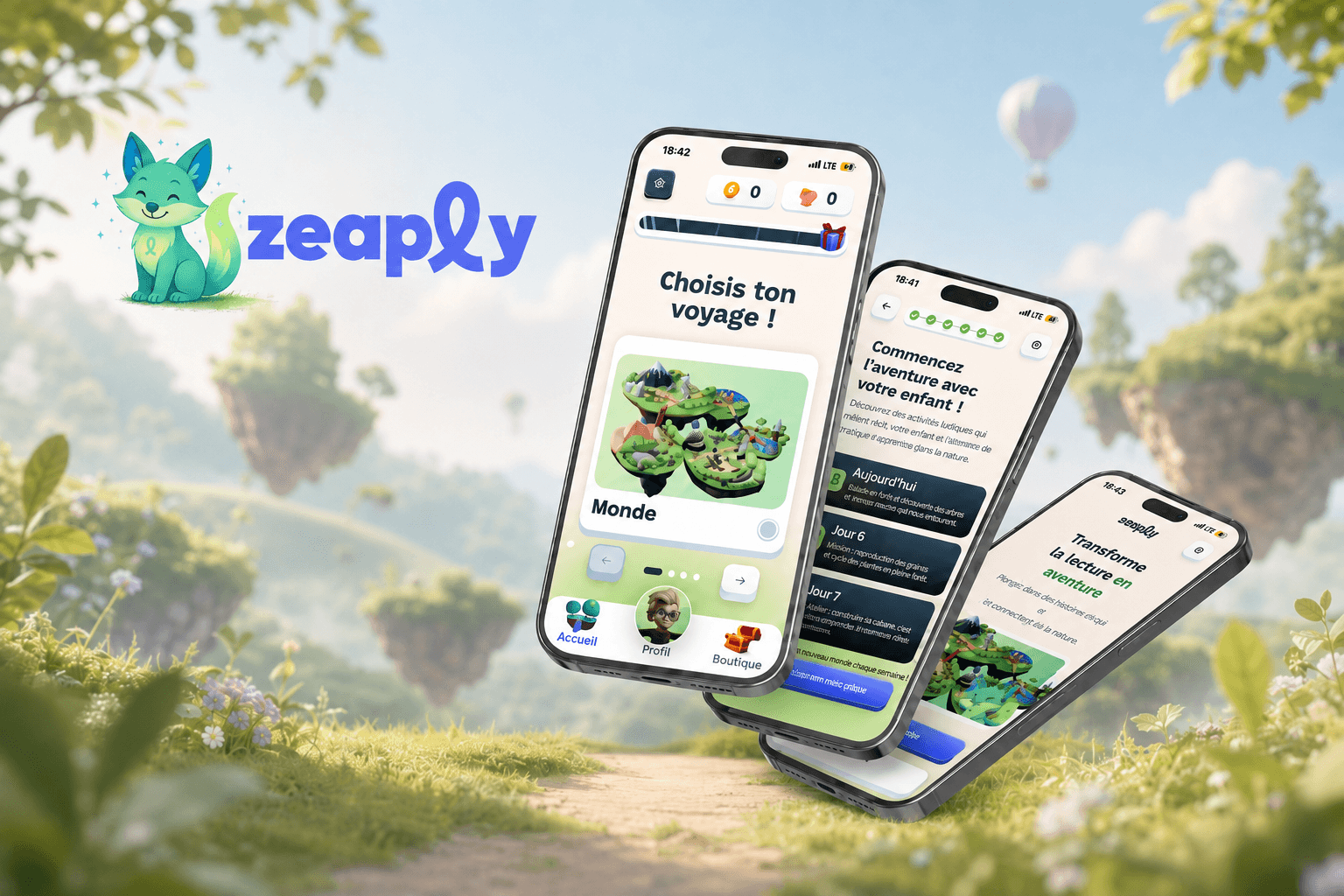
Zeaply gives children guided reading practice on iPhone and iPad. A child reads aloud, the product observes where the session becomes difficult, and later work adapts to the sounds, words, and fluency that need more attention. A story about helping a fox recover missing pages turns progress into a visible adventure.
Priority Soft joined after the product was live. We audited the child and parent experience, identified technical and UX problems that could interrupt a paid session, and prepared a stabilization plan for the existing team.
The work connected performance, responsive layout, microphone permission, blocked content, diagnostic visibility, and localization around one outcome: a child should be able to begin and complete reading practice without the application becoming the hardest part.
Auditing the live product
A requirements document cannot reveal how a live educational app behaves on a smaller phone, an older tablet, or a device where microphone access was denied months ago.
The audit began with the released application. We followed onboarding, parent setup, child selection, narrative progress, lesson entry, read-aloud activity, completion, and rewards on real device formats.
Client walkthroughs provided the intended teaching and product context. Independent review then tested whether that intent remained visible when the app was loading, blocked, interrupted, or displayed outside the ideal screen size.
The audit mapped each problem to the child or parent action it interrupted. That gave the team more useful context than a list organized by screen or component.
Protecting concentration during a reading session
Reading aloud already asks a child to coordinate attention, decoding, speech, and confidence. Lag or visual instability adds an unrelated cognitive burden.
The session review covered delayed transitions, dropped responsiveness, animation cost, memory pressure, and moments where the interface appeared to ignore a tap. We distinguished decoration that supported the story from effects that competed with the learning task.
The stabilization plan prioritized the route from lesson start through recording and completion. A performance issue in an optional shop matters, but a crash or frozen control during reading threatens the product's central promise.
The plan asked the team to measure the affected stage, reduce excess work, and simplify expensive visual behavior where needed. Representative phones and tablets would verify the improvement across devices.
Making microphone permission understandable
The read-aloud experience depends on microphone access. A mobile operating system can deny or restrict that permission. A parent may also have disabled it in device settings during an earlier session.
An ordinary disabled button gives a child no useful explanation and leaves a parent unsure whether the lesson, account, or device is broken.
Microphone permission became its own product state. Before a recording step, the application should know whether access is available, can still be requested, or must be changed in device settings. Each condition needs a clear message and an age-appropriate next action.
The child experience can ask for adult help without showing a technical error. The parent path explains how to restore access and returns to the interrupted lesson.
Responsive layouts for phones and tablets
Children may use a parent's phone, a shared tablet, or an older iPad with very different proportions. Fixed layouts can crop story text, place actions outside reach, or stretch artwork until the reading hierarchy disappears.
We tested narrow and wide screens, portrait behavior, safe areas, text growth, and the space required by the keyboard or system overlays.
The plan separated content that should scale from content that should reflow. Illustration can adapt within a bounded region, while reading text needs a stable measure and legible size. Primary actions should remain visible without covering the passage.
Tablet design received its own attention. The larger canvas creates more reading space while keeping navigation and reward cues connected to the lesson. It does not scale every element by the same amount.
Blocked content that explains why
An adaptive or subscription-supported product can prevent access for several reasons. A lesson may not be reached yet, a parent action may be required, an entitlement may be missing, or an earlier step may still need completion.
A single greyed-out card cannot tell the family whether to wait, pay, retry, or contact support.
The blocked-state inventory connected each condition with a reason and next action. Narrative progress needs a different explanation from an account problem. A paid boundary needs different language from content scheduled for later.
The app can explain the available next step while private entitlement and account records remain in the service.
A complete lesson path, including failure states
The main reading path starts recording, evaluates the passage, shows progress, and opens the next step. The product also needs to handle interruptions around that path.
Recovery review focused on what the child sees when audio fails to start, the connection weakens, processing takes longer, the app returns from the background, or the service cannot interpret the result.
Recommendations defined visible recording state, safe retry points, progress messages, and recovery that avoids duplicate sessions. The app should label reading as saved only after service confirmation.
The end of the session also matters. Feedback needs to celebrate completion without turning a reading observation into a diagnosis. The next action should remain clear whether the child earned narrative progress, a reward, or another practice recommendation.
Adaptive practice without a clinical claim
Zeaply uses read-aloud performance to adjust later exercises. The feature personalizes practice and makes no medical assessment.
The audit kept this boundary explicit. Interface language should describe observed difficulty in the session and the practice selected next. It should not label a child, diagnose dyslexia, replace a teacher or speech professional, or guarantee a learning result.
Parent-facing progress can show completed work and changes in supported reading measures without presenting a clinical conclusion. Child-facing feedback can encourage effort and explain the next activity in simpler terms.
The app can complement school or professional support. Microphone-based analysis alone cannot establish a condition or prescribe treatment.
The fox narrative as functional motivation
Zeaply wraps practice in a story about helping a fox recover missing pages. The narrative gives the child a reason to return and turns a sequence of lessons into visible progress.
Usability review also covered the story layer. A reward should arrive after the service records the learning state. Animation should support the transition without delaying the next activity or exhausting memory on lower-powered devices.
Locked chapters and recovered pages need to agree with the actual learning state. If visual progress and service progress diverge, the child may believe completed work was lost.
The boutique and reward layer can support motivation, but it should remain secondary to reading. The stabilization plan kept the lesson route available and understandable even when optional reward content was loading or unavailable.
Parent and child roles with different information needs
The parent manages accounts, profiles, permissions, purchases, and support. The child needs a focused path into the next session.
We identified where the application should change voice and control depth between those roles. Technical settings and subscription explanations belong in the adult context. Reading instructions, recording feedback, and narrative progress need language a child can follow.
Multiple child profiles require another safety check. The app shows the active profile before a session begins and returns results to that same child.
This case study omits parent identities, child profiles, reading results, account status, and family usage history.
Logging that helps without recording the child twice
Performance and audio-related bugs can be difficult to reproduce. Useful diagnostics need to show device context, application state, and where the lesson failed.
The logging and error-tracking review included privacy from the start. Developers need structured events around permission, recording start, processing state, navigation, memory warnings, and failure categories. They do not need a child's full profile or raw reading audio copied into general error logs.
The recommendations separated operational identifiers from personal content. Environment and version data give developers enough context to connect related events and identify release-specific problems.
This provides a route from parent report to actionable investigation while keeping recordings and child information inside the systems designed to protect them.
Comparing reading tools in a controlled mode
Speech and reading components can respond in different ways to accents, ages, devices, room noise, and passage types. Switching providers inside the customer experience would make comparison unreliable and expose children to experiments.
We proposed a controlled development mode for evaluating supported alternatives against the same synthetic or authorized test scenarios. The team could compare responsiveness, failure behavior, and useful output without exposing an experimental selector to children.
The mode would keep provider results out of ordinary accounts and record the information required for comparison. Representative test sessions would support the decision.
No private provider configuration, benchmark data, recordings, or selection decision is published here.
Preparing a French product for more languages
The existing application contained French text embedded across screens and lesson behavior. Adding another language by duplicating pages would make every future correction slower and invite inconsistencies.
The stabilization plan recommends a centralized localization layer. Interface messages, parent guidance, error states, narrative copy, and learning content require different handling. Each should draw from a stable language source outside the screens.
English served as an early development locale and exposed assumptions about text length and grammar. The broader plan separates interface translation from the work required to localize reading instruction.
Educational content, speech recognition, phonics, and pronunciation are language-specific. A localized interface does not by itself establish that the reading curriculum or analysis works in another language.
Prioritizing by impact, not by visual visibility
A polished screen can contain a minor alignment issue and a severe invisible memory problem. Treating every observation as an equal ticket would waste the team's attention.
Issues were ranked by their effect on session completion and family trust. Crashes, microphone dead ends, lost progress, and device-layout failures came before animation polish. Subscription and blocked-state confusion came before decorative inconsistencies.
Each recommendation connected the symptom and affected role to an area of investigation and a verification method. The product team received a stabilization sequence, with screenshots serving as evidence rather than the structure of the report.
The plan also distinguished confirmed behavior from hypotheses that required instrumentation or code access. That prevented an audit observation from being presented as a proven root cause.
Release support without claiming ownership of the codebase
Priority Soft worked with the existing live application and the client's development context. We supported release planning, device checks, diagnostic improvements, and the product decisions needed to address the highest-risk session problems.
No mapped Zeaply repository was available in the case-study evidence. This public page makes no claim that Priority Soft built the original adaptive engine, mobile architecture, account service, or every recommendation described here.
Our contribution was the audit, stabilization direction, UX diagnosis, localization planning, and release support established through the reviewed work. That role is substantial without rewriting the history of the product.
This evidence boundary also keeps technical detail at the right level. No routes, schemas, source structure, access secrets, internal logs, or provider configuration are presented.
A live product with a clearer improvement path
Zeaply remains available for iPhone and iPad. Its public listing describes read-aloud practice that adapts later sessions and shows continued bug-fix releases after launch.
The client received a product-wide view of the work. Performance, permissions, responsive layout, lesson recovery, role clarity, diagnostics, and localization were treated as connected parts of one reading experience.
The audit produced a prioritized plan based on the moments when a child or parent could no longer understand or continue the product.
The outcome
Zeaply gained a detailed stabilization and improvement plan for its live reading application. Priority Soft audited the route from parent setup through child onboarding, read-aloud practice, adaptive progression, rewards, and completion across real device constraints.
The work identified how performance, microphone access, blocked states, responsive layouts, logging, provider evaluation, and localization could be improved without exposing child data or making clinical claims.
The existing team gained a clear engineering priority: preserve concentration and let the child finish the reading session. This case study keeps profiles, recordings, lesson material, analytics, logs, commercial records, and unavailable source details private.